
Thursday, January 26, 2012
Early Chinatown in West Oakland

Reading the travel page of the USA Today newspaper it list Oakland Chinatown as one of the 10 great places to celebrate the Chinese Year of the Dragon. Chinese New Year's Eve starts January 22, 2012 and end with the Lantern Festival, February 2,2012.
San Francisco may boast that it’s has the nation's oldest Chinatown, the article states Oakland feels less touristy, a read place. Some would call it personality!
Did you know the early Chinatown in the mid-late 1800’s was located in West Oakland? Do you know where? Some of you may recognize the location when looking at the picture below. 
At the turn of the century, Oakland was California’s second largest city, with a population of 67,000. When the 1906 earthquake struck, Oakland suffered considerable damage, but it avoided the devastating fires that crippled San Francisco. Oakland’s residents responded quickly to the disaster and welcomed almost 200,000 San Franciscans who sought refuge.
Oakland’s Chinatown boomed during the influx. Overnight Oakland, with its port and railroad lines, banks, and communication lines, became the base for the relief effort.


Friday, January 20, 2012
Artist who played in the Prescott: Etta James & Johnny Otis
Okay, raise your hand if you know that Etta James played here in the Prescott neighborhood clubs?
Like many early soul singers, she began performing in church, before switching to R&B music, recording classic songs like “Something’s Gotta Hold On Me” and one of popular music’s most memorable ballads, “At Last.”
Etta James’ influenced a variety of musicians, including Bonnie Raitt, The Rolling Stones, Rod Stewart, Diana Ross, Janis Joplin and even Christina Aguilera. Etta’s music has been sampled by Hip-Hop artists including Common, Kanye West, and LMFAO.

So what was Etta and Johnny relationship? Johnny discovered Jamesetta Hawkins singing at in a talent show at a Los Angeles nightclub with the group Creolettes and gave the singer her stage name reversing Jamesetta into Etta James.

Did you know Johnny Otis played here in the Prescott neighborhood clubs?
And do you know the relationship between the two? Some information and answers are below.
First let me state this post does not intend to tell the life story of either artist; there are extensive stories elsewhere.
The intention of this post is to remind folks that the Prescott neighborhood has long been an incubator for crafts persons and artist of all genres. I have been privileged to experience the pre-post office 7th street nightclubs as well as the surrounding clubs and continual diversity of the artist in the neighborhood. With the help of social media, the incubator has grown to include most of West Oakland.
Etta James:
Born Jamesetta Hawkins in Los Angeles in 1938.Etta James:
Like many early soul singers, she began performing in church, before switching to R&B music, recording classic songs like “Something’s Gotta Hold On Me” and one of popular music’s most memorable ballads, “At Last.”
Etta James’ influenced a variety of musicians, including Bonnie Raitt, The Rolling Stones, Rod Stewart, Diana Ross, Janis Joplin and even Christina Aguilera. Etta’s music has been sampled by Hip-Hop artists including Common, Kanye West, and LMFAO.
In the movie Cadillac Records, Beyoncé Knowles played Etta James and sings At Last at http://youtu.be/9BNOl5njHRY and All I Can Do Is Cry at http://youtu.be/dh-0jH4Rb7Y.
When Esther’s Orbit Room opened in 1963, Etta James, Al Green and T-Bone Walker was among the performances.
Johnny Otis
Born Ioannis Alexandres Veliotes in Vallejo in 1921.
He began his musical career in 1939 as a drummer with Count Otis Matthew's West Oakland House Rockers playing in the Prescott neighborhood nightclubs. Enough said…


R.I.P.
R&B icon Etta James died today, January 20th 2012 in a Riverside, California hospital. She was 73.
Johnny Otis, the musician, bandleader, songwriter, impresario, disc jockey and talent scout who died on Tuesday, January 17th 2012 at his home in Altadena, Calif. He was 90.
Monday, January 16, 2012
Oakland’s dedication to Martin Luther King Jr.
AAMLO Annual MLK Film Festival, Monday, January 16th, 2012, 11:00 AM to 7:00 PM

The African American Museum & Library is honored to continue its traditional Martin Luther King, Jr. film festival by presenting a selection of critically acclaimed documentaries that put into historical perspective the nation defining-movement of the 1950s and 1960s for African American civil rights. (Source)
Dedications to Martin Luther King Jr.
Martin Luther King Jr. Regional Shoreline In 1987, East Oakland community activist Ira Jinkins planted a magnolia tree in San Leandro Shoreline Park in honor of Dr. Martin Luther King, Jr. In 1993 Jinkins’ lone tree was expanded to an entire grove of trees and a native plant garden by the East Bay Regional Park District. The park was renamed Martin Luther King, Jr. Regional Shoreline Park at that time. (Source)
The Martin Luther King, Jr. Freedom Center was born of their dreams and of a joint agreement between the City of Oakland, the East Bay Regional Park District, the Port of Oakland, the California State Coastal Conservancy, the Martin Luther King, Jr. March & Rally Committee and then State Assembly Member Barbara Lee. (Source)
Oakland's Martin Luther King Jr Elementary School serves grades K-5 in the Oakland Unified School District.
Martin Luther King Jr. Branch Library closed for renovation until May 1st, 2012, contains a developing special collection on Martin Luther King Jr. features books, videos, audiotapes, and DVDs. The branch also houses a Black History Collection, which contains adult fiction, non-fiction and biographies written by or about people of African descent. (Source)
Martin Luther King Jr Way (née Grove Street) Grove Street, which stretched for several miles north from Downtown Oakland into North Berkeley, was renamed Martin Luther King Jr. Way in 1984. The street had once represented the dividing line between neighborhoods where minorities could and could not live or buy property. (Source)
There are nearly a million documents associated with the life of Martin Luther King Jr.
Check it out here http://www.thekingcenter.org/archive
Friday, January 6, 2012
Slow progress on Seventh Street...
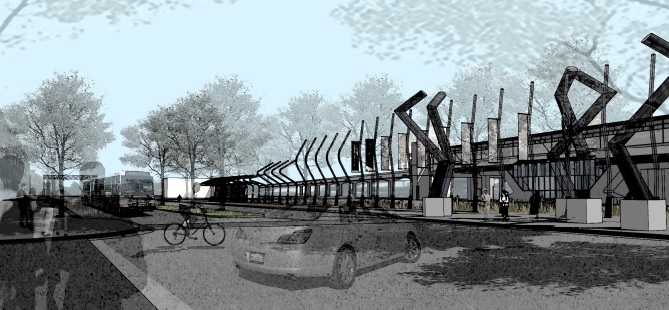
West Oakland’s Seventh Street has witnessed its share of changes over the years.
As the western terminus of the First Transcontinental Railroad, Seventh Street served as a business and cultural center for decades through the early- and mid-20th century. But changes in transportation including the addition of freeways, the diminishing role of the railways and eventually the addition of the BART system cut West Oakland off from downtown and the waterfront, transforming this once vibrant and creative community into just another stop along the route to San Francisco.
The complete story at Oakland Local, click here
Subscribe to:
Posts (Atom)